Senin, 20 April 2015

Cikapundung Rafting -Bandung City Tour


Cikapundung River stretches along 28 Km has long been a hallmark of the city of Bandung. Tipped in North Bandung, this river can be seen from the waterfall Curug Dago, splitting Tamansari and Cihampelas, until reaching Alun-alun.


Cikapundung, splitting Cihampelas area to Alun-alun. Cikapundung offers several natural attractions. The most famous attraction is rafting or white water rafting. This water sport allows travelers to directly “taste” the swift flow of the river and the clash of natural stones, while enjoying a semi-urban scenery along the riverbanks. Rafting route that can be used only as long as 4,300 m. This route starts from Dago Bengkok and finished in Babakan Siliwangi. Visitors can climb the big rubber boat that can seat up to six passengers, or riverboat ridden individuals.


Water tour was organized by Cikapundung Rehabilitation Program (CRP). They are combined with the aim of preserving the volunteer community Cikapundung River. Interestingly, while the tourists play water, they also must required to take out the garbage that they encountered in the river.
In practice, while wading the river tourists given sacks used to pick up garbage that they all encountered along the route of rafting.


Another option, especially if the water is receding, we can play a ban-banan. It is not much different from the rafting, but only using large tires that can be boarded individuals. Ford a river with tires is a typical game kids Cikapundung banks. Enough to capitalize tires, visitors can feel the twists and turns of the river, go with the flow.


Curug Dago
Another Cikapundung tour can be seen is the waterfall Dago. 10 m high waterfall is impressed 'dormant', but its location is very close to the center of the tourist crowds in Jl. Juanda (Dago). Waterfall which is part of the park Ir. H. Juanda is near Terminal Dago and can be achieved by using a motorcycle or on foot, but the road to the waterfall is very steep, uneven and slippery when wet. Arriving at the top of the waterfall Dago, vehicles must be parked in the space provided and to see from the ground had to walk about 300m. This path is not less steep. The thunder of the water helped fill the atmosphere and sounds of insects on shade trees add to the natural atmosphere. Thundering waterfalls echoed on the walls of the cliff that embrace it.
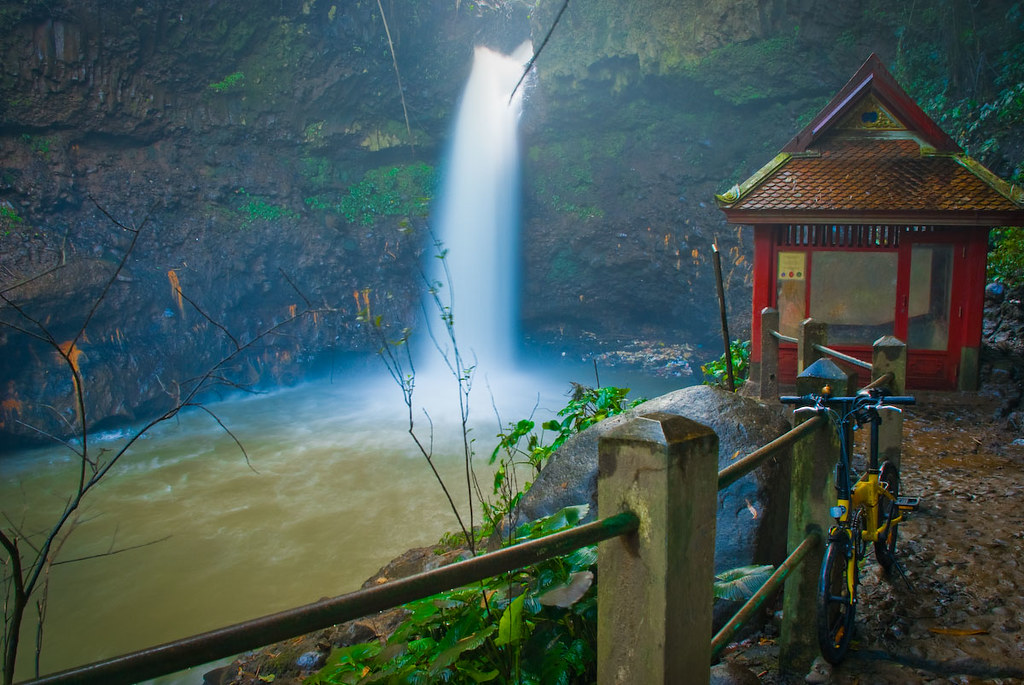
Dago waterfall also save valuable history. There are two oriental buildings housing a two inscriptions. According to historians, this inscription is a relic of the King of Thailand, Rama 5 (Chulalongkorn) and Rama 7 (Pradjathipok Pharaminthara) in the 17th century.

This tourist place seemed deserted on weekdays, but when asked at a local shop sellers, visitors who come are usually only a schoolboy at the weekend. Seeing that there is no hint or advertisement on Dago waterfall on the way to here, no wonder why many do not know. In addition to the steep streets, such as boarding facilities were dirty with graffiti break irresponsible. The waterfall itself is filled with floating garbage, even the occasional unpleasant aroma wafted on the water.

One thing that is repeatedly emphasized me when is rubbish. He complained that current Cikapundung River basin that stretches a giant landfill in Bandung. Starting from plastic waste, food wrappers, food, livestock manure, and even human waste was directly discharged into the river. Garbage began gathering of downstream Cikapundung, and accumulate closer to the city.

Cikapundung flow passing Jl Asia-Africa, had become midden.
There have been many who do CRP extension to the community so as not to pollute the river, even a team of CRP is not uncommon drop langung to clean up the garbage that looks and plant trees around the river. Through this action is expected to have a public embarrassment for littering in the river.

CRP was not put this place to be a tourist place, so it does not herald the hype through a variety of media. Usually people know information about the activities of CRP from Facebook, banner, or just word of mouth. Factors to be considered include the condition of clean water and discharge water is not erratic. Thus, rafting can not be open at all times.

Cleaning still using simple tools, such as saws, plastic, or sack to take the trash. Bandung City Government is currently focusing Cikapundung River to be a superior natural attractions in the city of Bandung. This major project is run under the leadership of institutions Planning Agency. This discourse can only be done when the river is free of trash and safe to visit the community.


Minggu, 29 Maret 2015

Animal

ELECTRIC EEL
The electric eel (Electrophorus electricus) is an electric fish, and the only species in its genus. It is capable of generating powerful electric shocks of up to 860 volts, which it uses for hunting, self-defense and communicating with fellow eels. It is an apex predator in its South American range despite living in an environment rich in predators such as humans, dogs, caimans, jaguars, giant otters, giant snakes, and birds of prey that kill fish of similar size of the electric eel as prey.  Despite its name, it is not an eel, but rather a knifefish.

Anatomy


The electric eel has an elongated, cylindrical body, typically growing to about 2 m (6 ft 7 in) in length, and 20 kg (44 lb) in weight, making it the largest species of the Gymnotiformes.The coloration is dark gray-brown on the back and yellow or orange on the belly. Mature males have a darker color on the belly. They have no scales. The mouth is square, and positioned at the end of the snout. The anal fin extends the length of the body to the tip of the tail. As in other ostariophysan fishes, the swim bladder has two chambers. The anterior chamber is connected to the inner ear by a series of small bones derived from neck vertebrae called the Weberian apparatus, which greatly enhances its hearing capability. The posterior chamber extends along the whole length of the body and maintains the fish's buoyancy. E. electricus has a well-developed sense of hearing. This fish has a vascularized respiratory organ in its oral cavity. As obligate air-breathers, electric eels must rise to the surface every 10 minutes or so to inhale before returning to the bottom. Nearly 80% of the oxygen used by the fish is retrieved in this way.
Despite its name, the electric eel is not closely related to the true eels (Anguilliformes), but is a member of the neotropical knifefish order (Gymnotiformes), which is more closely related to the catfish.

Physiology

The electric eel has three abdominal pairs of organs that produce electricity: the main organ, the Hunter's organ, and the Sach's organ. These organs make up four-fifths of its body, and are what give the electric eel the ability to generate two types of electric organ discharges: low voltage and high voltage. These organs are made of electrocytes, lined up so a current of ions can flow through them and stacked so each one adds to a potential difference. When the eel locates its prey, the brain sends a signal through the nervous system to the electrocytes. This opens the ion channels, allowing sodium to flow through, reversing the polarity momentarily. By causing a sudden difference in electric potential, it generates an electric current in a manner similar to a battery, in which stacked plates each produce an electric potential difference. In the electric eel, some 5,000 to 6,000 stacked electroplaques are capable of producing a shock at up to 600 volts and 1 ampere of current (600 watts) for a duration of two milliseconds. It would be extremely unlikely for such a shock to be deadly for an adult human, due to the very short duration of the discharge. Still, this level of current could in theory cause fatal electrocution in humans, depending on the path the current takes through the human body, and the duration of current flow. Heart fibrillation (reversible via a heart defibrillator) can be triggered by electric currents of 700 mA for more than 30 ms.
The Sach's organ is associated with electrolocation. Inside the organ are many muscle-like cells, called electrocytes. Each cell can only produce 0.15 V, though the organ can transmit a signal of nearly 10 V overall in amplitude at around 25 Hz in frequency. These signals are emitted by the main organ; the Hunter's organ can emit signals at rates of several hundred Hertz.
The electric eel is unique among the Gymnotiformes in having large electric organs capable of producing potentially-lethal discharges that allow them to stun prey. Larger voltages have been reported, but the typical output is sufficient to stun or deter virtually any animal. Juveniles produce smaller voltages (about 100 V). They are capable of varying the intensity of the electric discharge, using lower discharges for hunting and higher intensities for stunning prey, or defending themselves. When agitated, they are capable of producing these intermittent electric shocks over a period of at least an hour without tiring.
The electric eel also possesses high-frequency-sensitive tuberous receptors, which are distributed in patches over its body. This feature is apparently useful for hunting other Gymnotiformes.
Electric eels have been used as a model in the study of bioelectrogenesis. The species is of some interest to researchers, who make use of its acetylcholinesterase and adenosine triphosphate.

Bionics

Researchers at Yale University and the National Institute of Standards and Technology argue artificial cells could be built that not only replicate the electrical behavior of electric eel cells, but also improve on them. Artificial versions of the eel's electricity-generating cells could be developed as a power source for medical implants and other microscopic devices.
Habitat
Electric eels inhabit fresh waters of the Amazon and Orinoco River basins in South America, in floodplains, swamps, creeks, small rivers, and coastal plains. They often live on muddy bottoms in calm or stagnant water.
Feeding ecology
Electric eels feed on invertebrates, although adult eels may also consume fish and small mammals. First-born hatchlings will eat other eggs and embryos from later clutches.The juveniles will eat invertebrates, such as shrimps and crabs.
Reproduction
The electric eel is known for its unusual breeding behavior. In the dry season, a male eel makes a nest from his saliva into which the female lays her eggs. As many as 3,000 young will hatch from the eggs in one nest. Male electric eels are much smaller than the females


Selasa, 17 Maret 2015

DEWA ATHENA

In 21 february 2014. my school held DEWA ATHENA. DEWA ATHENA is a sport week event only happen annualy, so it's very fantastic. DEWA ATHENA has slogan fortuna fortex iufat (fortune favours the brave). DEWA ATHENA has a mascot, the mascot is sonic. at 6.30 me and my friend went to Bali court and meet up at futsal/voli court. so at 7 o'clock the event start. there is three opening in this event. 1. second Yasril and the third was Mr Encang. then Mr Encang open this event he's hope the student will be more healthy with this event. after that we went to color run around Bali court, saparua, jawa street, Siliwangi street, sumatra street and then finish in Bali court. When we reached the court we sprayed with water colorful so that our clothes being colored and then competition begins. Finally the compettion begins, the competition begins with a football game between the winner of BM cup against the all star. After that the competition begins. The first competition is estafet. We get a turn first in the competition . This competition finally began at 10 . We fight the class 11. We finally suffered loss in the competition. After that we got our turn to play dodge ball and futsal. It turns out that having a conflicting competition so we have to divide our class into two. I was chosen to play futsal. unfortunately our dodge ball team get loss . this think make my futsal team Eager to beat the enemy . Finally our group futsal obtain a victory . After that we also played tag of war and won that competition

Senin, 02 Februari 2015

Natural Phenomenon


A waterspout is an intense columnar vortex (usually appearing as a funnel-shaped cloud) that occurs over a body of water. They are connected to a towering cumuliform cloud or a cumulonimbus cloud. In the common form, it is a non-supercell tornado over water.

While it is often weaker than most of its land counterparts, stronger versions spawned by mesocyclones do occur. Waterspouts do not suck up water; they are small and weak rotating columns of air over water.

While waterspouts form mostly in the tropics and subtropical areas, other areas also report waterspouts, including Europe, New Zealand, the Great Lakes and Antarctica. Although rare, waterspouts have been observed in connection with lake-effect snowprecipitation bands.

Waterspouts have a five-part life cycle: formation of a dark spot on the water surface, spiral pattern on the water surface, formation of a spray ring, development of the visible condensation funnel, and ultimately decay.

Waterspouts exist on a microscale, where their environment is less than two kilometers in width. The cloud from which they develop can be as innocuous as a moderate cumulus, or as great as a supercell. While some waterspouts are strong and tornadic in nature, most are much weaker and caused by different atmospheric dynamics. They normally develop in moisture-laden environments as their parent clouds are in the process of development, and it is theorized they spin as they move up the surface boundary from the horizontal shear near the surface, and then stretch upwards to the cloud once the low level shear vortex aligns with a developing cumulus cloud or thunderstorm. Weak tornadoes, known as landspouts, have been shown to develop in a similar manner.More than one waterspout can occur in the same vicinity at the same time. As many as nine simultaneous waterspouts have been reported on Lake Michigan.

Waterspouts that are not associated with a rotating updraft of a supercell thunderstorm are known as "non-tornadic" or "fair-weather waterspouts", and are by far the most common type. Fair-weather waterspouts occur in coastal waters and are associated with dark, flat-bottomed, developing convective cumulus towers. Waterspouts of this type rapidly develop and dissipate, having life cycles shorter than 20 minutes. They usually rate no higher than EF0 on the Enhanced Fujita scale, generally exhibiting winds of less than 30 m/s (67 mph).

They are most frequently seen in tropical and sub-tropical climates, with upwards of 400 per year observed in the Florida Keys. They typically move slowly, if at all, since the cloud they are attached to is horizontally static, being formed by vertical convective action instead of the subduction/adduction interaction between colliding fronts.Fair-weather waterspouts are very similar in both appearance and mechanics to landspouts, and largely behave as such if they move ashore.

"Tornadic waterspouts", also accurately referred to as "tornadoes over water", are formed from mesocyclonic action in a manner essentially identical to traditional land-based tornadoes in connection with severe thunderstorms, but simply occurring over water.A tornado which travels from land to a body of water would also be considered a tornadic waterspout.Since the vast majority of mesocyclonic thunderstorms occur in land-locked areas of the United States, true tornadic waterspouts are correspondingly rarer than their fair-weather counterparts in that country. However, in some areas, such as the Adriatic, Aegean and Ionian seas, tornadic waterspouts can make up half of the total number.

A winter waterspout, also known as a snow devil, an icespout, an ice devil, a snownado, or asnowspout, is an extremely rare instance of a waterspout forming under the base of a snow squall.The term "winter waterspout" is used to differentiate between the common warm season waterspout and this rare winter season event. Very little is known about this phenomenon and only six known pictures of this event exist to date, four of which were taken in Ontario, Canada. There are a couple of critical criteria for the formation of a winter waterspout. Very cold temperatures need to be present over a body of water warm enough to produce fog resembling steam above the water's surface. Like the more efficient lake-effect snow events, winds focusing down the axis of long lakes enhance wind convergence and likely enhance their development.

There are five stages to the waterspout life cycle. Initially, a prominent circular, light-colored disk appears on the surface of the water, surrounded by a larger dark area of indeterminate shape. After the formation of these colored disks on the water, a pattern of light and dark-colored spiral bands develop from the dark spot on the water surface. Then, a dense annulus of sea spray, called a cascade, appears around the dark spot with what appears to be an eye. Eventually, the waterspout becomes a visible funnel from the water surface to the overhead cloud. The spray vortex can rise to a height of several hundred feet or more and often creates a visible wake and an associated wave train as it moves. Eventually, the funnel and spray vortex begin to dissipate as the inflow of warm air into the vortex weakens, ending the waterspout's life cycle.


source :

Senin, 26 Januari 2015

Advertisement


To get the best performance and features from your Android smartphone or tablet you should make sure you're always running the very latest software available for it, not just in terms of apps but also the Android operating system. In our  electronic stores at jl.belitung barat no 731 a you can upgrade your android version with just $9.99

Android has been heavily criticised for its OS fragmentation - as of 7 July 2014, 13.5 percent of devices were still running Android 2.3.3-2.3.7 Gingerbread, 11.4 percent were still running 4.0.4-4.0.4 Ice Cream Sandwich, and 56.5 percent were running 4.1-4.3 Jelly Bean. Given that we (or, at least, 17.9 percent of the Android-owning population) are now running Android 4.4 KitKat and know The Android Lollipop 5.0 update for the android handphone has started to roll out. Samsung has worked at lightning pace to deliver Lollipop so quickly after it was first released – it would almost be rude not to install it! come here so you can get Android 5.0 on your android handphone.

It's not just about device stability and speed, either. New operating system updates bring new features, such as Jelly Bean's multiple user accounts and KitKat's improved Google Now and smarter Caller ID, when Lollipop launches in the next few months, will bring a new material design, enhanced notifications, as well as a huge improvement to battery life. Here some features Android Lollipop has to offer.

  • Material Design
A bold, colorful, and responsive UI design for consistent, intuitive experiences across all your devices
    • Responsive, natural motion, realistic lighting and shadows, and familiar visual elements make it easier to navigate your device
    • Vivid new colors, typography, and edge-to-edge imagery help to focus your attention
  • Notifications
New ways to control when and how you receive messages - only get interrupted when you want to be 
    • View and respond to messages directly from your lock screen. Includes the ability to hide sensitive content for these notifications
    • For fewer disruptions, turn on Priority mode via your device’s volume button so only certain people and notifications get through. Or schedule recurring downtime like 10pm to 8am when only Priority notifications can get through
    • With Lollipop, incoming phone calls won’t interrupt what you’re watching or playing. You can choose to answer the call or just keep doing what you’re doing
    • Control the notifications triggered by your apps; hide sensitive content and prioritize or turn off the app’s notifications entirely
    • More intelligent ranking of notifications based on who they’re from and the type of communication. See all your notifications in one place by tapping the top of the screen
  • Battery
Power for the long haul
    • A battery saver feature which extends device use by up to 90 mins
    • Estimated time left to fully charge is displayed when your device is plugged in
    • Estimated time left on your device before you need to charge again can now be found in battery settings
  • Security
Keep your stuff safe and sound
    • New devices come with encryption automatically turned on to help protect data on lost or stolen devices
    • SELinux enforcing for all applications means even better protection against vulnerabilities and malware
    • Use Android Smart Lock to secure your phone or tablet by pairing it with a trusted device like your wearable or even your car
  • Device Sharing
More flexible sharing with family and friends
    • Multiple users for phones. If you forget your phone, you still can call any of your friends (or access any of your messages, photos etc.) by simply logging into another Android phone running Lollipop. Also perfect for families who want to share a phone, but not their stuff
    • Guest user for phones and tablets means you can lend your device and not your info
    • Screen pinning: pin your screen so another user can access just that content without messing with your other stuff
  • New Quick Settings
Get to the most frequently used settings with just two swipes down from the top of the screen
    • New handy controls like flashlight, hotspot, screen rotation and cast screen controls
    • Easier on/off toggles for Wi-Fi, Bluetooth, and location
    • Manually adjust your brightness for certain conditions. Then, adaptive brightness will kick in based on ambient lighting
  • Connectivity
A better internet connection everywhere and more powerful Bluetooth low energy capabilities
    • Improved network handoffs resulting in limited interruption in connectivity. For example, continue your video chat or VoIP calls without interruption as you leave the house and switch from your home Wi-Fi back to cellular
    • Improved network selection logic so that your device connects only if there is a verified internet connection on Wi-Fi
    • Power-efficient scanning for nearby Bluetooth low energy (“BLE”) devices like wearables or beacons
    • New BLE peripheral mode
  • Runtime and Performance
A faster, smoother and more powerful computing experience
    • ART, an entirely new Android runtime, improves application performance and responsiveness
      • Up to 4x performance improvements
      • Smoother UI for complex, visually rich applications
      • Compacting backgrounded apps and services so you can do more at once
    • Support for 64 bit devices, like the Nexus 9, brings desktop class CPUs to Android
      • Support for 64-bit SoCs using ARM, x86, and MIPS-based cores
      • Shipping 64-bit native apps like Chrome, Gmail, Calendar, Google Play Music, and more
      • Pure Java language apps run as 64-bit apps automatically
  • Media
Bolder graphics and improved audio, video, and camera capabilities
    • Lower latency audio input ensuring that music and communication applications that have strict delay requirements provide an amazing realtime experience
    • Multi-channel audio stream mixing means professional audio applications can now mix up to eight channels including 5.1 and 7.1 channels
    • USB Audio support means you can plug USB microphones, speakers, and a myriad of other USB audio devices like amplifiers and mixers into your Android device
    • OpenGL ES 3.1 and Android extension pack brings Android to the forefront of mobile graphics putting it on par with desktop and console class performance
    • A range of new professional photography features for Android Lollipop that let you
      • Capture full resolution frames around 30 fps
      • Support raw formats like YUV and Bayer RAW
      • Control capture settings for the sensor, lens, and flash per individual frame
      • Capture metadata like noise models and optical information
    • State of the art video technology with support for HEVC to allow for UHD 4K video playback, tunneled video for high quality video playback on Android TV and improved HLS support for streaming
  • OK Google
Easy access to information and performing tasks
    • Even if your screen is off, you can say "OK Google" on devices with digital signal processing support such as Nexus 6 and Nexus 9
    • Talk to Google on the go to get quick answers, send a text, get directions and more
  • Android TV
Support for living room devices
    • User interface adapted for the living room
    • Less browsing, more watching with personalized recommendations for content like movies and TV shows
    • Voice search for Google Play, YouTube and supported apps so you can just say what you want to see
    • Console-style Android gaming on your TV with a gamepad
    • Cast your favorite entertainment apps to your big screen with Google Cast support for Android TV devices
  • Accessibility
Enhanced low vision and color blind capabilities
    • Boost text contrast or invert colors to improve legibility
    • Adjust display to improve color differentiation
  • Now in 68+ languages
15 new additions
    • Basque, Bengali, Burmese, Chinese (Hong Kong), Galician, Icelandic, Kannada, Kyrgyz, Macedonian, Malayalam, Marathi, Nepali, Sinhala, Tamil, Telugu
  • Device set up
Get up and running in no-time
    • Tap & go: instant set up of your new Android phone or tablet by simply tapping it to your old one (requires NFC)
    • Whenever you get a new Android phone or tablet, you can bring over your apps from Google Play automatically from any of your old Android devices
  • And a whole lot more
    • Tap & pay: easily manage multiple payment apps by quickly switching between them
    • Print preview and page range support
    • Revamped display for battery, Bluetooth, data usage, and Wi-Fi settings and new search functionality in settings
    • New device level feedback for Nexus devices in Settings > about phone > send feedback
    • Easier sharing with
      • Improved ranking of your options within the share menu
      • Android Beam: lets you share a file with someone nearby by gently tapping the two devices together
    • Where supported by the hardware, your device will wake up as soon as you pick it up or tap the screen twice
    • Improved hardware keyboard accessory support including support for multilingual, emoji input, search key, and improved app and system key chords  

Thank you for your attention and don't forget to come to our  electronic stores at jl.belitung barat no 731 a

Minggu, 18 Januari 2015

Food Massaman Curry


Now I will discuss about food that caught my attention. This food is the most delicious in the world. This food is in the first place in here http://travel.cnn.com/explorations/eat/worlds-50-most-delicious-foods-067535. Indonesian rendang is in 11 but know we don't talk about rendang but we talk about Massaman curry. This food is from thailand. It's name Massaman curry. These foods have a price around 60.000-150.000 rupiah. Massaman or matsaman is not a native Thai word. It is generally thought to refer to the Muslims with earlier writers from the mid-19th century calling the dish "Mussulman curry"; Mussulman being an archaic form of the word Muslim.The curry is extolled in a poem from the end of the 18th century, attributed to Prince Itsarasunthon of Siam, the later King Rama II (1767-1824). It is dedicated to a lady who is believed to be Princess Bunrot, the later Queen Sri Suyendra, wife of King Rama II. 
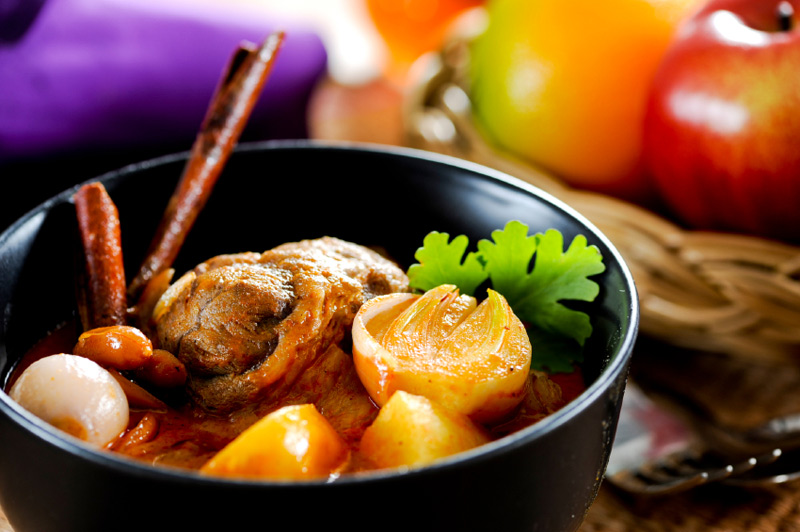
Due to its Muslim roots and therefore islamic dietary laws, this curry is most commonly made with beef, but there are also variations on this dish using duck, chicken, mutton, goat, or, less commonly so, pork. As pork is haram meat  (forbidden food in Islam) this last variant is of course not eaten by  muslim.The flavors of the massaman curry paste (nam phrik kaeng matsaman) come from spices that are not frequently used in other Thai curries. cardamom, cinnamon,cloves, star anise, cumin, bay leaves,nutmeg and mace would, in the 17th century, have been brought to Thailand from the Malay Archipelago and South Asia by foreigners, a trade originally dominated by Muslim traders from the Middle EastIndian subcontinent and from the archipelago itself, but increasingly threatened by the Portuguese, the Dutch and French East India Company These are combined with local produce such as dried chili pepperscilantro (coriander) seeds, lemongrassgalangal, white pepper, shrimp pasteshallots and garlic to make the massaman curry paste. This paste is first fried with coconut cream, and only then are meat, potatoes, onions, fish sauce or salt, tamarind paste, sugar, coconut milk and peanuts added. Massaman is usually eaten with rice, in a meal together with other dishes. There are also traditional versions using oranges, orange juice, or pineapple juice as additional ingredients. 


 If you want to make this Massaman curry here i give the procedure to make massaman curry.

 Ingredients

  • 1/2 lb. beef shoulder (chuck roast) or stew beef, sliced
  • 3 tablespoon whole raw peanuts
  • 4 cup water
  • 1 medium-sized potato, cut into 1 inch cubes
  • 1 tablespoon cooking oil (soybean, peanut or corn oil)
  • 3-4 tablespoon Massaman curry paste, homemade or ready-made (we recommend excellent Nittaya brand)
  • 1 1/2-2 cups coconut milk Chaokoh brand coconut milk
  • 6 whole Thai cardamom seeds, cracked and dry roasted*
  • 1 inch piece of cinnamon stick, dry roasted*
  • 2 tablespoon Thai fish sauce
  • 1 tablespoon palm sugar
  • 2 tablespoon tamarind water
  • 1/4 large white onion, cut into pieces (or 12 peeled whole white pearl onions)

Preparation

  1. Open the coconut milk and scoop the thick coconut cream from the top and set aside (see more details about coconut cream).
  2. Bring the 4 cup of water, beef and peanuts to boil, skimming the scum from the surface for about 5 minutes. Lower heat to medium and continue to cook at a low boil uncovered, for approximately one hour. Remove from the heat and set aside.
  3. Separately, bring the potatoes to boil in enough water to cover for approximately 20 minutes until just slightly under-cooked (al dente). Drain and discard the potato water (or reserve to make your own sourdough mix!). Set the potatoes aside. While the beef is cooking you may make the homemade Massaman Curry Paste.
  4. Heat oil in a large wok (or other large heavy bottom pan) over medium heat, add the curry paste and cook briefly until fragrant. Add the reserved coconut cream and fry until it begins to separate, stirring constantly. Add the boiled beef and peanuts in its broth and remainder of coconut milk, fish sauce, palm sugar, tamarind, cinnamon stick, potatoes and onion. Bring to a boil. Reduce heat to low and cook 10 minutes.
  5. Adjust seasoning with fish sauce, palm sugar and tamarind water to taste. Massaman curry should be slightly sweet with a very subtle sour note from the tamarind. Serve with pickled ginger or cucumber relish as condiments.
Serves 4. This curry is even better the next day, reheated, so make double portion and freeze any left-overs.


Selasa, 13 Januari 2015

My Holiday In White Crater


On December 25, 2014.  Me, my brother and my mom went with my uncle to the white craters.White Crater is a striking crater lake and tourist spot in a volcanic crater about 50 km south of Bandung in West Java in Indonesia. In the way there we drove through villages and crossed a bridge and a river. I went there by car which takes approximately 2 hours. There are many thousands of small market-crop farmers in the fertile valley to the south of Bandung which leads up towards the Kawah Putih area. Local food-crops grown include a wide range of fruits and vegetables. A strawberry industry is well-established in the area and many strawberry farms have fruit for sale along the
side of the highway. When we arrived there, we stopped at the foot of the mountain to buy some food because no one is selling food at the peak of White Crater. After that we bought tickets costing 100,000 rupiah. We can take a car that had been provided by staff to reach the Summit craters but i went to the summit with my own car. Finally we reached the Summit of the White Crater. On the way from the foot mountain to the top takes about 10 minutes. On the way to the top of white crater I saw some hikers who walk to the crater of Mount White. I think the hikers were very tiredness to reach the summit White Crater. The air from the top of the crater white very fresh but I also smell the sulfur.

Area around the White Crate was very clean and the parking lot was very organized. From the parking lot we must walk to the crater. We must walk down the stairs that is pretty long to reach the crater. To go down into the crater we are advised to wear masks because of the stench of sulfur in the crater is quite intense. We are also only allowed to visit the crater just for 15 minutes because if more than that then it can cause dizziness and nausea. When we descended the staircase we will see some information boards that tell us about white crater.The lake is said to have been first documented in the western world in 1837 by Dr Franz Willhelm Junghuhn, a German botanist who carried out a considerable amount of research in Indonesia. At the time, there were various local stories about the history of the area. Birds were said to be reluctant to fly near the region and villagers in the area tended to regard the forest around the lake as eerie and somewhat mysterious. These stories prompted Dr Junghuhn to investigate. He discovered Kawah Putih. There was formerly a sulfur mine at the crater although production has now ceased. A sulfur plant known as the Zwavel Ontgining Kawah Putih was first established near the lake during the period of Dutch rule in Java. The plant was later taken over during World War II by the Japanese military and operated under the name Kawah Putih Kenzanka Yokoya Ciwidey. Entry points to various tunnels which represent the remnants of these mining activities can be seen at several points around the current site. Around the white craters we can also see a very beautiful forest. Finally we reached the crater.

The crater was very beautiful and the smell of sulfur was strong because there was a good deal of steam and sulfurous gas bubbling from the lake. At the moment it is fairly crowded around the crater  because it was visited by tourists and that day is the holiday. Beside we enjoyed the crater we took many picture too in the crater. Once satisfied to see the crater we returned to the car and went home.